
When you buy a property, the price is not the only thing you pay. Property transfer fees in Punjab add roughly 3% to 4% to the price for a buyer who is a tax filer, and much more for a non-filer. Several of these charges changed in 2026: the federal budget lowered advance tax for filers, Punjab set stamp duty at 1%, and PLRA revised its registration fees.
This guide lists every charge a buyer and seller pay in 2026-27, shows a worked example for a Rs1 crore house in Lahore, and explains how to pay. We update it when rates change.
What are the property transfer fees in Punjab in 2026-27?
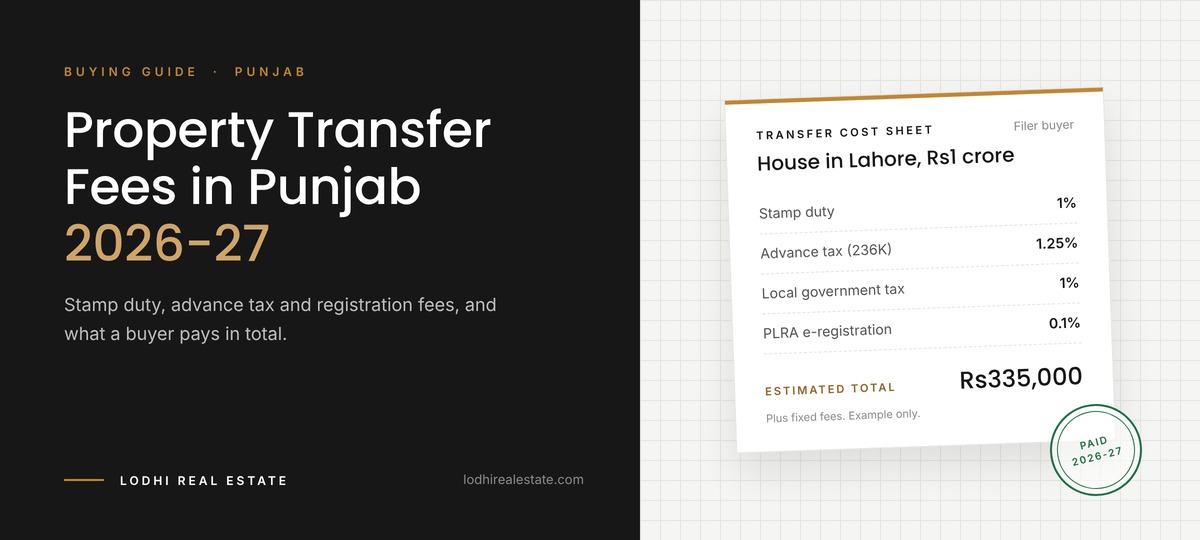
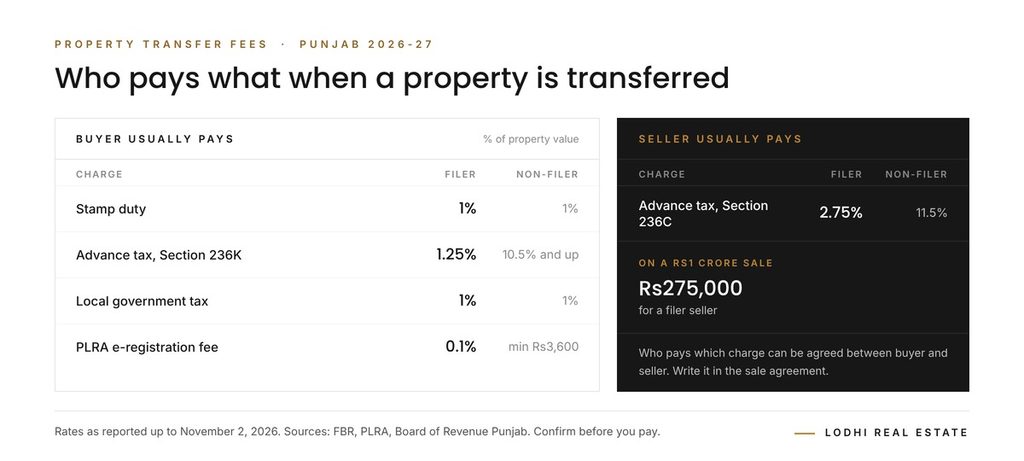
For a buyer on the Active Taxpayers List, the main charges are 1% stamp duty, 1.25% advance tax, 1% local government tax and a 0.1% PLRA e-registration fee. The seller pays 2.75% advance tax.
| Charge | Who usually pays | Filer | Non-filer |
|---|---|---|---|
| Stamp duty | Buyer | 1% | 1% |
| Advance tax on purchase (Section 236K) | Buyer | 1.25% | 10.5% to 18.5% |
| Local government tax on transfer | Buyer | 1% | 1% |
| PLRA e-registration fee | Buyer | 0.1%, minimum Rs3,600 | 0.1%, minimum Rs3,600 |
| Advance tax on sale (Section 236C) | Seller | 2.75% | 11.5% |
Each charge is worked out on a different value. Stamp duty and local government tax use the district’s DC valuation rate, or the price in the deed if that is higher. Advance tax uses the FBR valuation table. In a prime area, the FBR value can be much higher than the DC rate.
Stamp duty in Punjab: now 1%
Stamp duty is the provincial tax on the sale deed. In April 2026, the Stamp (Amendment) Ordinance set it at 1% of the property’s value in both urban and rural areas. Before that, rural property was charged 3%. Registry offices were still listing stamp duty at 1% in July 2026.
You pay stamp duty by buying an e-stamp paper for the full amount before registration.
Advance tax for buyers and sellers (236K and 236C)
These are federal taxes collected by FBR at the time of transfer. The Finance Act 2026 replaced the old value-based slabs for filers with flat rates from the 2026-27 tax year:
- Buyer (Section 236K): 1.25% of the FBR value for filers, down from 1.5% to 2.5% last year.
- Seller (Section 236C): 2.75% of the sale price for filers, down from 4.5% to 5.5% last year.
If you are not on FBR’s Active Taxpayers List (ATL), you pay far more. Buyers pay 10.5% on property up to Rs50 million, 14.5% from Rs50 million to Rs100 million, and 18.5% above that. Sellers pay 11.5%. Check your ATL status on the FBR website with your CNIC before you agree on a deal.
These taxes are adjustable: a filer can claim them against their income tax for the year.
Local government tax, CVT and fixed fees
- Local government tax: urban property transfers carry a 1% tax for the local government, shown as “corporation tax” on registry fee lists. Cantonment areas charge more; Rawalpindi registries listed 3% for cantonment property in July 2026.
- Capital Value Tax (CVT): some transfers of urban property in Punjab also carry CVT, which recent reports put at 2% of the DC value. It does not appear on every registry fee list, so ask the sub-registrar whether it applies to your property.
- PLRA fees for 2026-27:
- E-registration of a sale: 0.1% of the value (minimum Rs3,600).
- Ordinary mutation: Rs1,200 (express Rs11,200).
- Fard copy: Rs900 (express Rs4,000).
- Copy of a registered deed: Rs1,400.
- Registration and comparison fees: small fixed amounts. Rawalpindi registry offices listed Rs1,000 and Rs500 in July 2026.
Worked example: a Rs1 crore house in Lahore
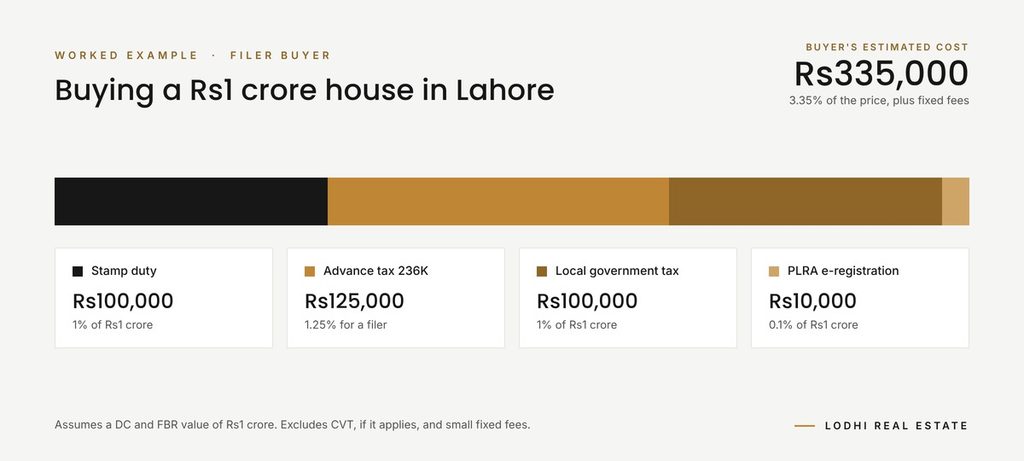
Say you are a filer buying a house where the DC value, FBR value and price are all Rs1 crore:
| Charge | Amount |
|---|---|
| Stamp duty (1%) | Rs100,000 |
| Advance tax, 236K (1.25%) | Rs125,000 |
| Local government tax (1%) | Rs100,000 |
| PLRA e-registration (0.1%) | Rs10,000 |
| Buyer’s total | Rs335,000 (3.35%) |
Fixed fees come on top, plus Rs200,000 more if 2% CVT applies to your property. The seller, if a filer, pays Rs275,000 under Section 236C.
If the same buyer were a non-filer, advance tax alone would be Rs1,050,000. Becoming a filer before you buy saves more than Rs9 lakh on this deal.
Fees for LDA schemes and housing societies
For a plot or house in an LDA scheme such as Johar Town, or in a private housing society, the transfer goes through that authority or society. The charges are different:
- The authority or society charges its own transfer fee. Ask its office for the current amount.
- PLRA charges Rs3,000 per transaction through its Property Transfer System.
- Federal advance tax (236K for the buyer, 236C for the seller) still applies.
Gifts, inheritance and exchanges: what changed in October 2026
The Stamp (Second Amendment) Ordinance 2026, reported on October 28, 2026, made these changes:
- Inheritance: no stamp duty or fees on transferring inherited property to the legal heirs.
- Gift deeds (hiba): no stamp duty on gifts between spouses, parents and children, grandparents and grandchildren, and siblings. Other gifts are charged 1%, down from 2%.
- Property exchange: Rs1,000 if the two properties are of equal value. Otherwise, 1% of the difference.
An ordinance is temporary unless the Punjab Assembly passes it as law, so confirm these rules on the day you register.
How to pay property transfer fees in Punjab, step by step
- Check the DC rate for your area and the FBR value of the property.
- Check that both buyer and seller are on FBR’s Active Taxpayers List.
- Pay the advance tax (236K and 236C) through FBR’s e-payment system and keep the receipts.
- Buy e-stamp paper for the stamp duty.
- Pay the local government tax and other fees as the sub-registrar directs.
- Register the deed with biometric verification of both buyer and seller, at the sub-registrar or the Arazi Record Centre.
- Have the mutation entered in the land record, and collect a copy of the registered deed.
Before any of this, confirm the seller’s ownership documents. Our guides on what to check before paying token money and the Green Property Certificate explain how.
Who pays the transfer fees, buyer or seller?
By custom in Lahore, the buyer pays stamp duty, 236K advance tax, local government tax and registration fees, and the seller pays 236C advance tax. This is not fixed by law. Buyer and seller can agree to split costs differently, so write the agreed split into the sale agreement.
How Lodhi Real Estate helps
Lodhi Real Estate has helped clients buy, sell and rent property in Lahore since 2019, from our office in Zamzam Mall, Johar Town. Before you agree on a price, we work out the property transfer fees in Punjab that apply to your deal, so you know the full cost up front.
If you are buying or selling in Johar Town or anywhere in Lahore, call or WhatsApp us at +92 333 557 4103, or browse our current properties.
Frequently asked questions
How much does it cost to transfer property in Punjab in 2026?
For a filer buyer, the main charges come to about 3.35% of the property’s value: 1% stamp duty, 1.25% advance tax, 1% local government tax and 0.1% PLRA fee, plus small fixed fees. CVT may add 2% on some urban property. The seller pays 2.75% advance tax if they are a filer.
What is the stamp duty on property in Punjab?
Stamp duty is 1% of the property’s value in both urban and rural areas, after the Stamp (Amendment) Ordinance of April 2026. It is calculated on the DC valuation or the price in the deed, whichever is higher, and paid through e-stamp paper before registration.
How much advance tax does a buyer pay in 2026-27?
Under Section 236K, a buyer on FBR’s Active Taxpayers List pays 1.25% of the property’s FBR value. A non-filer pays 10.5% on property up to Rs50 million, and more above that. A filer can adjust this tax against their annual income tax.
Do non-filers pay more to transfer property?
Yes, much more. A non-filer buyer pays 10.5% to 18.5% advance tax instead of 1.25%, and a non-filer seller pays 11.5% instead of 2.75%. On a Rs1 crore house, a non-filer buyer pays over Rs9 lakh more in advance tax than a filer.
Is there stamp duty on a gift to family or on inherited property?
No, under the October 2026 ordinance. There is no stamp duty on gifts between spouses, parents and children, grandparents and grandchildren, and siblings. Inherited property can be transferred to the legal heirs with no stamp duty or fees. Other gifts carry 1% stamp duty.